
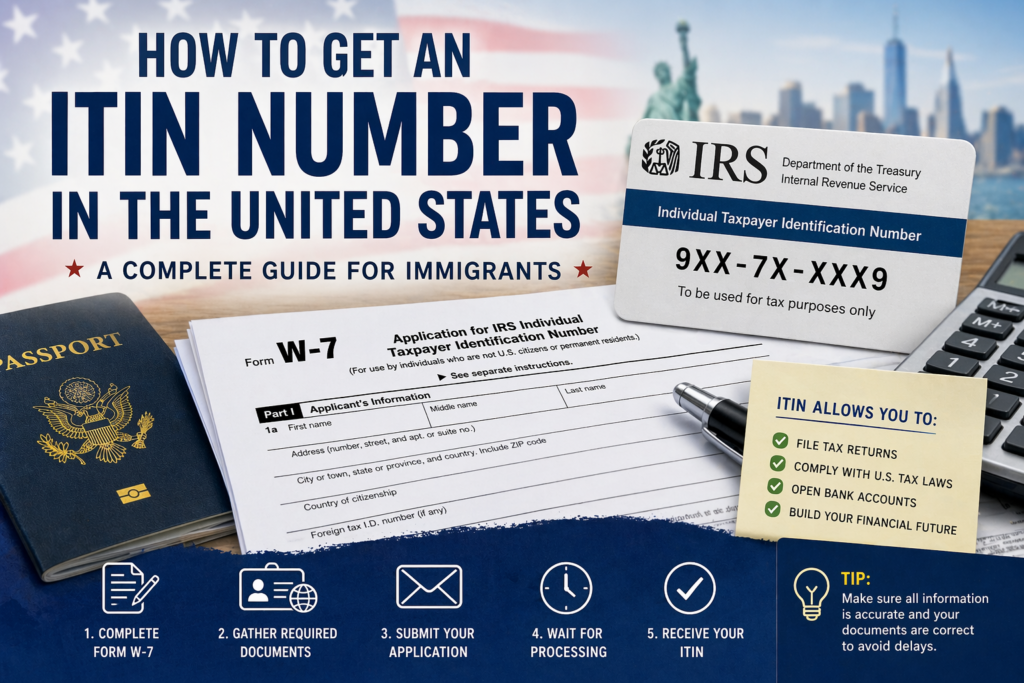
For many individuals living or working in the United States who are not eligible for a Social Security Number (SSN), obtaining an Individual Taxpayer Identification Number (ITIN) is essential.
An ITIN allows you to comply with U.S. tax laws, file tax returns, and access certain financial services. However, the application process can be confusing if you are not familiar with the requirements.
In this guide, we explain what an ITIN is, who needs it, and how to apply step by step, using official and up-to-date information.
What Is an ITIN?
An ITIN (Individual Taxpayer Identification Number) is a tax processing number issued by the Internal Revenue Service for individuals who are required to have a U.S. taxpayer identification number but are not eligible for a Social Security Number.
The ITIN is used exclusively for federal tax reporting purposes.
It does not:
- Provide legal immigration status
- Authorize you to work in the United States
- Qualify you for Social Security benefits
You can find official information here:
https://www.irs.gov/individuals/individual-taxpayer-identification-number
Who Needs an ITIN?
You may need an ITIN if you must file a U.S. tax return but do not qualify for a Social Security Number.
Common situations include:
- Nonresident or resident aliens filing U.S. taxes
- Undocumented individuals with income in the U.S.
- Dependents or spouses of U.S. citizens or residents
- Individuals claiming tax treaty benefits
If you are unsure whether you qualify, it is important to review your specific situation before applying.
Why Is an ITIN Important?
Having an ITIN allows you to:
- File your federal tax return
- Comply with U.S. tax laws
- Open certain bank accounts
- Build a financial record in the United States
In some cases, filing taxes with an ITIN can also support future immigration processes by demonstrating compliance with federal regulations.
Step-by-Step: How to Apply for an ITIN
Step 1: Complete Form W-7
To apply for an ITIN, you must complete Form W-7 (Application for IRS Individual Taxpayer Identification Number).
You can access the official form here:
https://www.irs.gov/forms-pubs/about-form-w-7
The form requires:
- Personal information
- Reason for applying
- Foreign status documentation
Make sure all information is accurate to avoid delays.
Step 2: Gather Required Documents
You must submit documentation to prove your identity and foreign status.
The most commonly accepted document is:
- A valid passport (standalone document)
If you do not have a passport, you may need to provide a combination of documents such as:
- National identification card
- Birth certificate
- Foreign driver’s license
The IRS provides a full list of acceptable documents here:
https://www.irs.gov/instructions/iw7
Step 3: Attach a Federal Tax Return
In most cases, your ITIN application must be submitted together with a federal tax return.
This is a key requirement.
There are some exceptions, but generally:
- You cannot apply for an ITIN without including a tax return
- The tax return will not be processed until the ITIN is assigned
Step 4: Submit Your Application
You have three main options to submit your ITIN application:
By mail:
Send your Form W-7, tax return, and original documents (or certified copies) to the IRS.
Through an IRS-authorized Certifying Acceptance Agent (CAA):
These professionals can verify your documents and help you avoid sending originals.
At an IRS Taxpayer Assistance Center (by appointment):
Some centers allow in-person verification.
You can find more details here:
https://www.irs.gov/individuals/how-do-i-apply-for-an-itin
Step 5: Wait for Processing
The IRS typically processes ITIN applications within 7 to 11 weeks, although this may vary during peak tax season.
Once approved, you will receive a letter with your ITIN.
When Do You Need to Renew an ITIN?
Not all ITINs remain valid indefinitely.
You must renew your ITIN if:
- It has not been used on a tax return in the past 3 years
- It contains middle digits that have expired (based on IRS rules)
Using an expired ITIN can delay your tax refund or processing.
You can check renewal details here:
https://www.irs.gov/individuals/itin-expiration-faqs
Common Mistakes to Avoid
Many ITIN applications are delayed or rejected due to simple errors.
Common mistakes include:
- Submitting incomplete forms
- Sending incorrect or uncertified documents
- Not attaching a tax return
- Selecting the wrong reason for applying
- Providing inconsistent information
Carefully reviewing your application can help prevent delays.
Why Professional Assistance Matters
Applying for an ITIN involves strict documentation requirements and IRS procedures. Even small errors can result in delays or rejections.
Working with experienced tax preparation professionals can help:
- Ensure your Form W-7 is completed correctly
- Verify your documents before submission
- Avoid sending original documents unnecessarily
- Reduce processing delays
Professional guidance can make the process faster and less stressful.
Get Help with Your ITIN Application
Obtaining an ITIN is an important step for individuals who need to meet their tax obligations in the United States.
At JNC Immigration & Tax Services, we assist clients with ITIN applications and tax preparation services.
Our team can help you:
- Complete your Form W-7 application
- Prepare and file your tax return
- Review required documents
- Avoid common IRS errors
If you need to apply for an ITIN or renew your existing number, we are here to support you.
Contact JNC Immigration & Tax Services today and get professional assistance with your ITIN application.
Disclaimer: The information provided in this article is for general educational and informational purposes only and should not be considered legal, tax, or financial advice. I am a tax preparer and not a licensed attorney, CPA, or financial advisor. Reading this article or relying on its contents does not create any client, legal, or professional relationship. Tax laws and regulations may change and vary based on individual circumstances. You should consult a qualified attorney, CPA, or other licensed professional regarding your specific situation before making any legal or financial decisions..
 ES
ES  EN
EN